The Battle of Los Angeles
—Chrissie
Listen here: https://www.spreaker.com/episode/hwts-280-the-battle-of-los-angeles--69446282
In the aftermath of the Japanese bombing of Pearl Harbor, the people living on the West Coast of the United States were, understandably, concerned for their safety. Though there were few attacks on the mainland United States during the War, one of the best-known was not an attack at all.
Shortly after 2 am on 25 February 1942, reports of enemy aircraft appeared on radar about 120 miles (193 km) west of Los Angeles. Coming two days after a Japanese submarine had shelled Ellwood Oil Field off the coast of Santa Barbara, people feared the worst. This was also only a few hours after an alert had been sounded and then cleared, leaving the city on edge. When the air raid sirens went off at 2:25 am, people thought the earlier all-clear had been mistaken. A blackout of the city was ordered, in hopes of preventing the enemy from finding their targets.
Over the next hour, the Los Angeles sky was lit up with a massive barrage of anti-aircraft fire, with approximately 1400 shells fired alongside countless rounds from machine guns. Though this ended around 4:30 am, the all clear was not given until almost three hours later. In the light of morning, the damage was surprising, not from enemy fire, but our own. Despite participants being absolutely certain they’d seen aircraft fall from the sky in spectacular fashion, there was no evidence of enemy aircraft at all. Even so, a great deal of damage had been done. Many houses were damaged with roofs and windows broken, and an unexploded shell sat on a North Beach golf course. Five people had died, three in car accidents as they tried to drive without headlights and two of heart attacks that were blamed on the stress of the moment.
The whole thing was blamed on a false alarm caused by, as Secretary of the Navy Frank Knox called it, “war nerves.” This was not a satisfactory explanation for most people, despite the logic of it. No one liked the idea of American servicemen being tricked by their own fears. Contradictory statements made over the next few days didn’t help: while Secretary Knox maintained it was a false alarm, Secretary of War Henry Stimson said the actions of the military were justified because as many as fifteen unidentified planes were seen over the city. It was even suggested that these were commercial planes flown by enemy agents, but Stimson later refuted this idea. After the war was over, Japanese records showed their planes had not been flown over Los Angeles at any point during the war. And so, it was left as an example of jumpy soldiers acting without checking, or a mysterious cover up by the American government. The former was far too mundane, while the latter offered a great deal of potential and interesting possibilities just as the mid-20th century popular interest in UFOs ramped up.
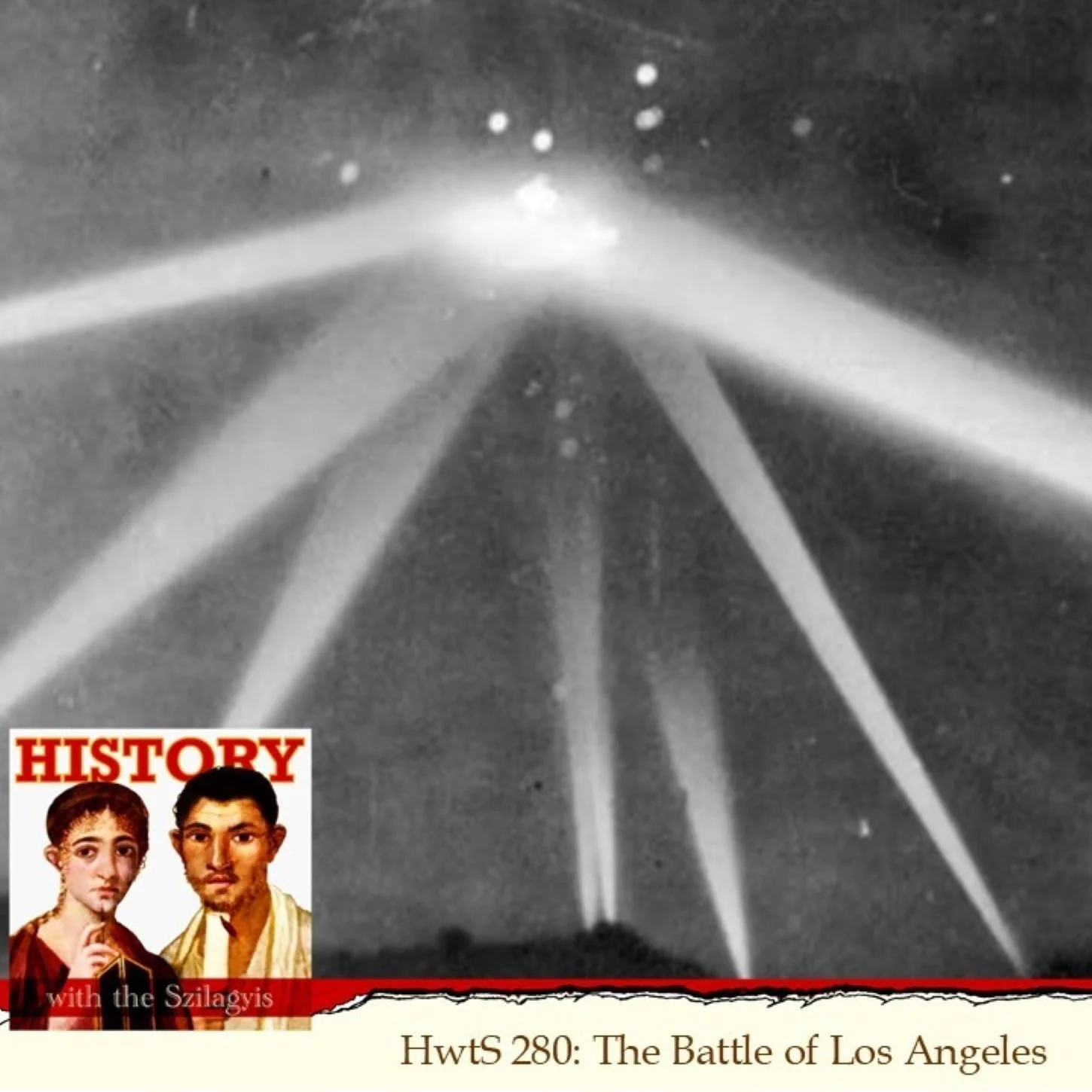
The centerpiece of evidence for the UFO explanation is the photo from the Los Angeles Times, which shows searchlights focused on what appears to be a disc-shaped aircraft. The fact that no wreckage was found is presented as supporting the theory—the alien craft was not harmed by human weapons. This was combined with other stories of UFO sightings during the war to support the idea that aliens were observing humanity, watching and judging our actions. This lines up with the beliefs around the later, and more famous, Roswell incident, in which a UFO crashed near White Sands, New Mexico. They are said to have been extraterrestrial observers who were watching to see how humanity would use its new ability to split the atom. Also like Roswell, the most logical explanation comes in the form of a balloon. Documents declassified in 1983 show several meteorological balloons were in the air that night and conclude these were the basis of the alarm. The LA Times photo also has a mundane explanation: the apparent object at the center of the lights is merely the lights themselves, poorly emphasized as the photo was developed and touched up to be clear in black and white newsprint.
As with so many historical events clung to by conspiracists of all types, historians are left in the impossible position of having to prove a negative. Having said that, I feel confident saying that it probably wasn’t a UFO that prompted all the shooting.